
An old
T-shirt
Jan 2026
Childhood is often imagined as something soft and unburdened, but for many of us it arrives shaped by adult urgency. Love shows up early, dressed as guidance, discipline, and hope. Parents want their children to be safe in a world that rarely is, and sometimes safety is mistaken for excellence. This is how a child learns effort before rest, and achievement before ease, not because they are unloved, but because they are loved fiercely, if imperfectly.
Over the years, I won many prizes. In fact, I started winning before my memories even had the chance to settle in. Every Sunday during winter and sometimes even in summer, I was thrust into a competition. My parents saw to that. It was a ritual, a hunger game where the stakes were unclear to me. All I was taught was that I had to win. Losing meant something dark and heavy would be waiting back home, a truth only those who have read Beethoven and I would understand.
There was a twisted thrill to it all. I remember the puffed-up pride that came with being the child who made mothers roll their eyes the moment they spotted me at the venue. Some of the other kids would burst into tears, convinced their chances had vanished just because I had shown up. Even now, I catch myself smiling at the memory.
Yet amidst this battlefield, there was one rival who stood out. Let’s call her Flower. She was two years older, and our rivalry was the stuff of whispered gossip. We never exchanged words. We just stared at each other with unspoken challenges burning between us. In our minds, the other competitors barely existed. This was a two-person showdown, just Flower and me, like gladiators in a ring.
Painting was my oxygen, my escape. Competition after competition, year after year, I came home clutching another prize. Flower claimed a few too, and when she did, I felt fear rather than envy. I was never upset about losing. I was afraid of what waited at home.
Bam!!!
By then, I had become something of a fixture. Organisers recognised my face and greeted me warmly, insisting I give a speech after every win. I hated it. Just hand me my prize and let me leave! Don’t force me to speak in front of 200+ people when I could barely string a sentence together. And then there were the cheek-squeezers—every adult, cooing and pinching my cheeks as if they were made of sweet, squishy Roshogolla.
Boundaries? Unheard of.
“Ahhh, gooook gooook goooooooooo!” they’d squeal, all unaware, while I wished I could disappear.
The Unfinished one
I remember one competition vividly. The theme was “landscape with a water feature” and we had one hour to complete it using pastels. I got lost in the process, lost in my colours and shapes. When the bell rang, I had barely filled in the sky, the mountain, the forest, and a little bit of the river. The tree, the hut, the ducks—they all remained untouched by colour.
My mother watched from the back, her expression sharpening with every uncoloured inch. It wasn’t a good look. Sure enough, I received a slap in front of everyone for not finishing my piece. The competition was part of a local fair, and we spent the rest of the day wandering among the stalls while my mother continued her lecture, expressing her disappointment in endless loops. I dreaded going home.
Evening rolled in, and it was time for the announcement. “Today’s winner for the best landscape representation in the children’s art category is — Avik Nandy” My mother and I were both shocked, standing there like statues. I went up to the stage, collected my prize and certificate. And yes, they squeezed my cheeks again
– oof!!
***
Then came the protests from the other moms. Cries of “cheating” and “partiality” filled the air. The judges, maintaining their composure, called for calm and brought all the drawings up on stage. One of them pointed to my work. “Show me a single piece that demonstrates this kind of colour mixing” they challenged. “No one else here has blended colours with this kind of skill ”. “Anyone can complete a drawing, but who here has the skill to make it a masterpiece?” Silence settled over the crowd like dust. The parents weren’t happy, their discontent simmering beneath the stillness, but they had no choice but to accept the result.
I never cared much about what people thought of my winning or losing. But I knew that when I didn’t win, it was like a festival for the parents in the audience. They’d point and laugh, revelling in my defeat. “Awww….., next time, kid!” they’d say. I couldn’t care less about their taunts. My real concern was what awaited me at home and how I could sidestep the impending scolding and beating.
But when it came down to me and Flower, I knew I had to win. Rivalry is a funny thing— it had grown on me like fibres woven tightly together, like a sweater you didn’t ask for but found yourself wrapped in anyway. And so, it was her or me, every time.
A State-level showdown
One state-level competition stands out in my memory. Hundreds of students gathered from all corners of the state, and naturally, Flower was there, casting her usual icy stare. The theme was announced— “imagination”. The parents in the crowd erupted. “This is ridiculous! Too hard for a child to draw! Stop this competition right now!” Protests were common where I grew up.
Disagree with something? Shout about it until someone listens.
But the judges weren’t having it. They hushed the crowd with a firm, “Let the children use their imagination, and shut up”.
I poured myself into the drawing, losing track of time as each stroke brought the scene to life. In the foreground stood a child with one leg, leaning against a tree with his crutches. His red T-shirt glowed under a hint of pink and white, capturing the soft sunlight that illuminated him. He wore black pants, and his expression was sombre, clutching a football as tears traced down his cheeks. In the background, other children played in shirts of blue, green, and pink, each paired with black pants, their laughter and games a distant contrast to his loneliness.
A small boat floated in the background, adding depth to the scene, while a lone bird pecked at the grass nearby, seemingly indifferent to the unfolding story. This time, I finished the drawing, every detail and colour precisely in place. My mother’s face softened; for once, I saw a glimmer of pride in her eyes.
The time came for the results. Guess who won the prize? – Avik Nandy.
Flower stood as the runner-up, and for a moment, our rivalry turned into a silent victory for me. The chief guest, a respected and renowned figure—someone whom everyone in India would recognise, whom I’ll call “Light” had personally chosen my drawing. He was mesmerised by the concept and the way I blended the colours. But just as they announced my name, a helicopter buzzed overhead—Light was whisked away for some urgent affair, leaving my win to echo in the sky.
I remember the thrill of seeing my drawing published in a newspaper—a moment that felt like a small taste of fame. To this day, I still have that old newspaper, with my drawing and name printed right there, a reminder of that time when my colours made it beyond the competition stage and into the world outside. Interestingly, the paper was printed in black and white. Back then, I don’t think we even had coloured newspapers. Such irony! I was known for my skill in blending colours, yet my proudest moment was captured in shades of grey.
The Trophy and the cheeks
I was like a living trophy. My mom carried me around with pride, parading me through each event, while I tried to dodge the endless cheek squeezes. With my tiny paw clasped around her hand, I held on tight, bracing myself for the inevitable.
As I climbed up to the stage to collect my prize, I braced myself.
Yes, the cheeks again. Bloody hell, what was with my cheeks?
They pressed and pinched, oblivious to my discomfort.
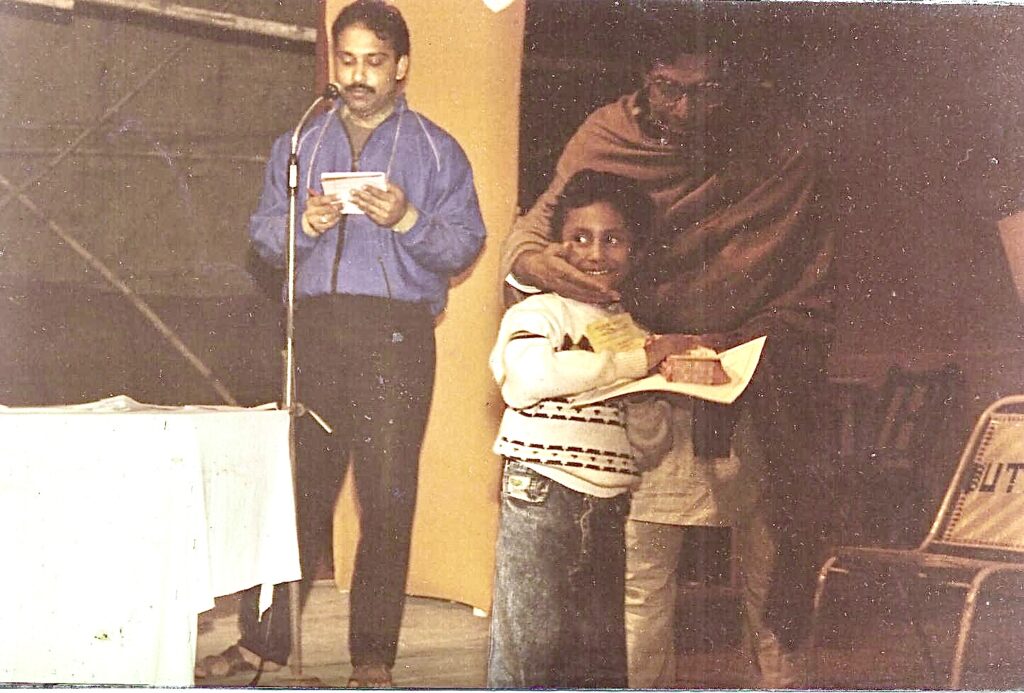
Then came the real surprise—a trophy almost my height and likely twice my weight! The crowd chuckled, and the judges made a joke about how I’d need help carrying it. Seeing me struggle with the weight, they called my dad up to the stage to help me lift the enormous prize. It was a special sight. My dad, who only came to the state-level competitions, joining me on stage, while Mum, my usual companion through every other event, watched from the audience. She was always the one taking me everywhere, unafraid and strong, guiding me through competitions all over the city. But on that stage, it was my dad who steadied the weight of that giant trophy, like a World Cup I’d only get to keep for six months before having to compete for it again.
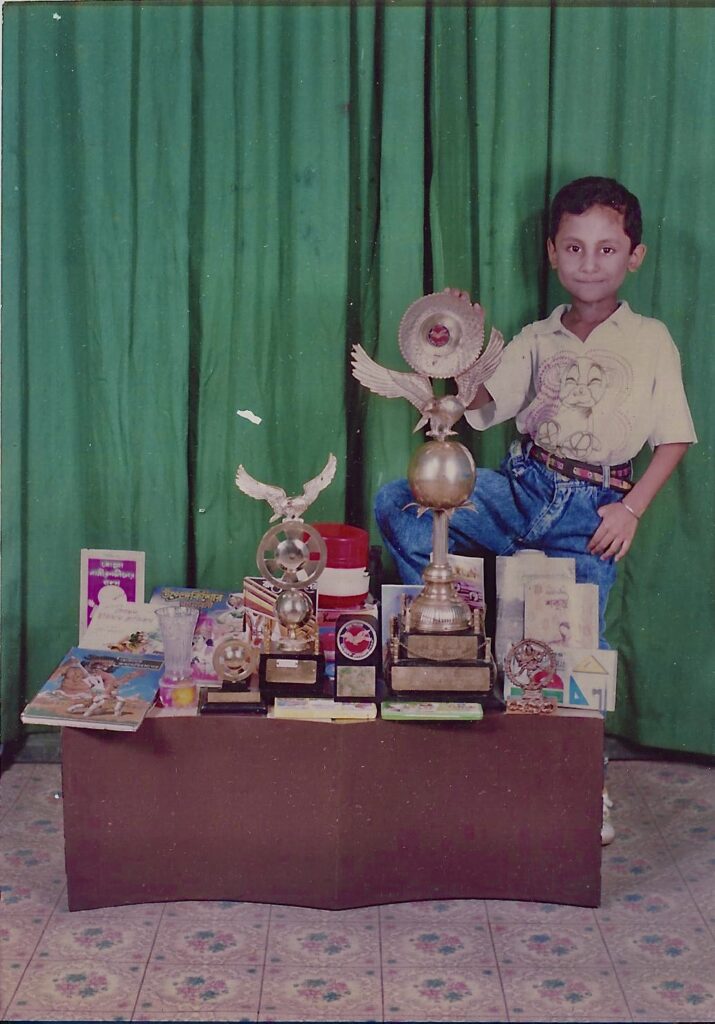
Each year after the state-level competition, my parents would gather up all the trophies I’d won that season and take me to the local studio for a photo shoot. It was a logistical nightmare, hauling everything over a kilometre to the studio, with my stick-figure arms carrying little more than a backpack. My mother, ever meticulous, would powder my face until I looked as bright as a fresh-cut marigold. I’d pose in my favourite denim jeans and my cherished T-shirt—a little too big for my stick figure, with a bunny on it, but no other shirt would do for these photos. I had to have that particular T-shirt. Trying to smile as she fussed over every detail, I stood there in my beloved shirt, year after year. Those photos captured my childhood, and that old T-shirt? She still keeps it!
Words of a mother
So tell me mom, why you pushed me so hard into painting.
“You were in Kindergarten Level-1, only three or four years old, taking your very first exam. Every day the teachers told me how well you were doing, how beautiful your handwriting was. I truly believed you would come first.
When the results came and I saw you were second, I couldn’t understand it. You had perfect scores in every subject except drawing. That was the only thing holding you back. And that’s when I decided to push you into drawing and painting.”
That old T-shirt still exists. A quiet relic of a time shaped by expectation, effort, and a kind of love that did not always know how to be gentle, but never meant to be unkind.
Some Things We Keep
by Avik Nandy
*1 The stories shared here don’t adhere to any specific timeframe; rather, they have unfolded across various chapters of my life, each resonating with the authenticity of my personal experiences.
Leave a comment
Let us know what you think. Can you relate yourself to this story?